184x impression growth in five months. The discovery phase before the harvest.
How an emerging-category property built its impression base from near-zero to 573,000 monthly impressions — and what the branded-vs-non-branded split reveals about what comes next.
73× in 6 months
Monthly Impressions Growth
25,350
Total Clicks (13.5 mo)
1.32M
Total Impressions
7.3
Average Position
TL;DR
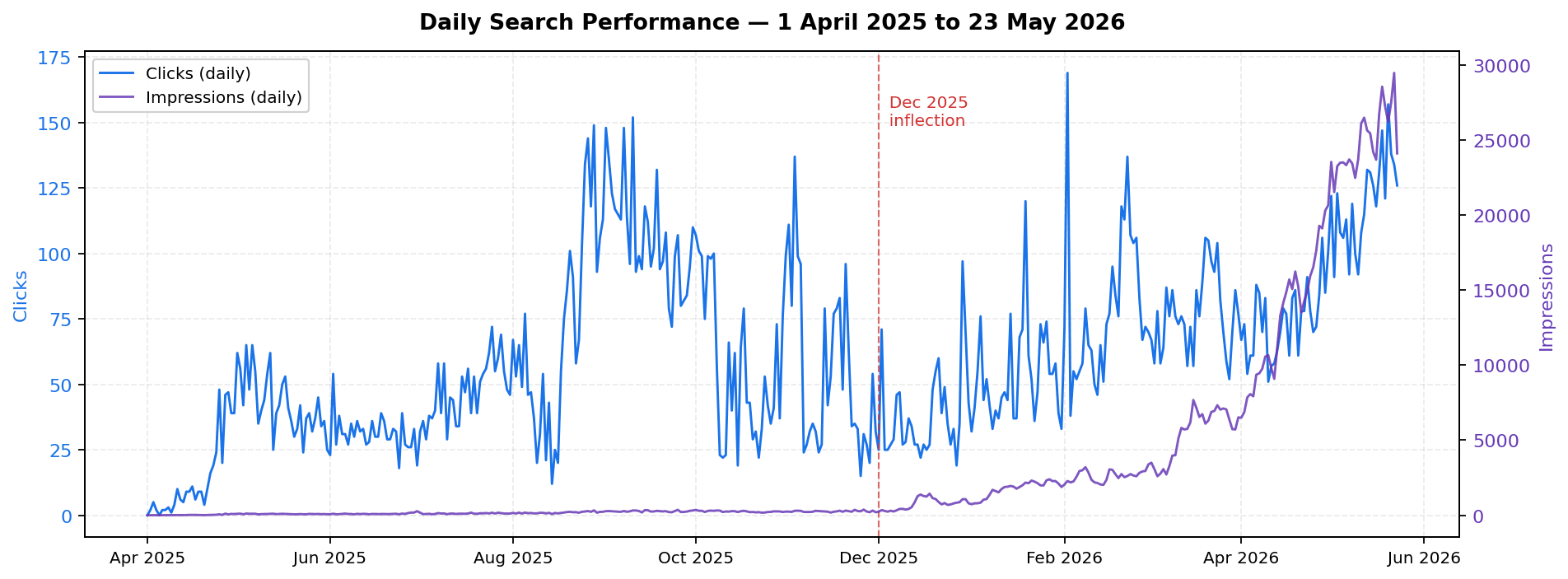
Across 13.5 months, the property pulled 25,350 clicks against 1,324,563 impressions at an average position of 7.3 and an overall CTR of 1.91%. Those are the totals. They are also the least interesting numbers in this document. The interesting numbers live in the inflection. For the first eight months, the property was effectively brand-only — 96% of clicks came from people Googling the brand name, average CTR was above 40%, and impressions never crossed 8,000 in a month. In December 2025, the indexable surface area jumped. Impressions went from 7,839 in November to 573,343 in May — a 73x increase in six months. Clicks roughly doubled. The category presence arrived. The click-through has not — yet.
The Challenge
The property operates in a vertical that is still in the act of becoming a category in India. Demand exists; the vocabulary is fragmented. Users do not type the category name — they type symptoms, foods, and home remedies in five languages on the same day. The conventional SEO play in such a vertical is to wait for the category to mature and then compete. The play here was the opposite: build the content surface area before the category arrives, and let the indexing compound when the queries do.
Results
The Inflection
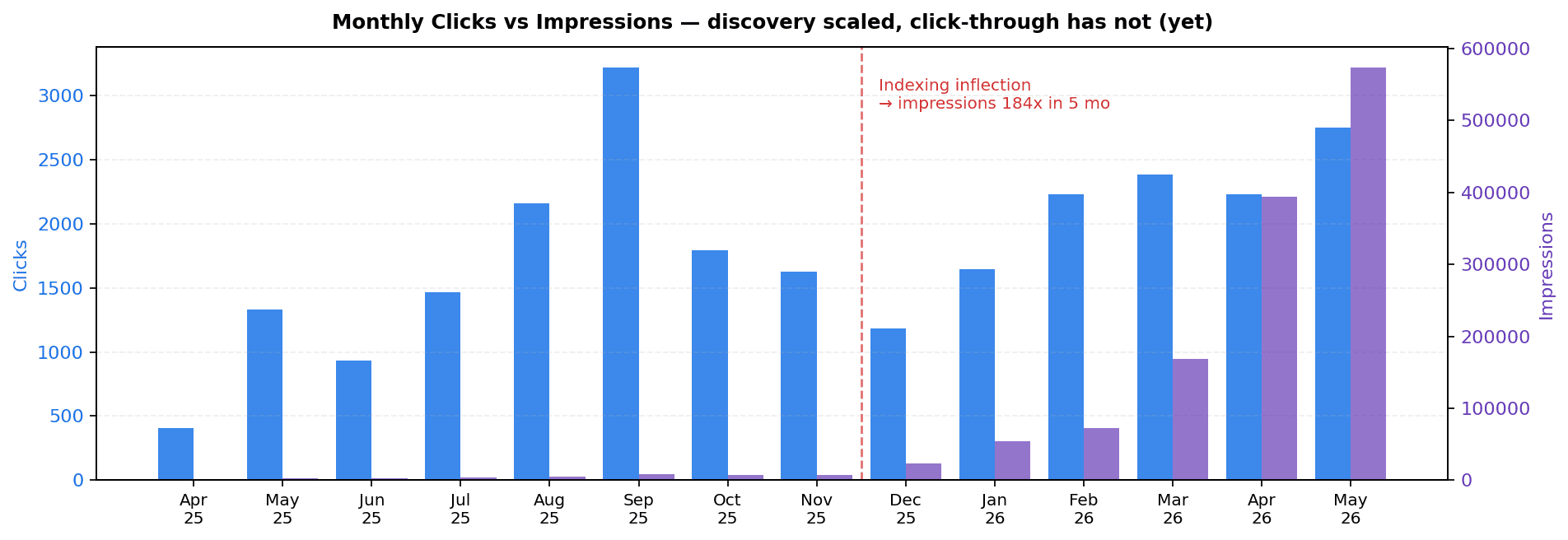
December 2025 is when the content engine started being seen. Monthly impressions moved from 7,839 (November) to 23,135 → 54,747 → 72,328 → 168,231 → 393,861 → 573,343 over the next six months. That is not a marketing curve. That is a search-index acceptance curve. The pages that had been published months earlier started getting picked up at scale — the symptom-meaning queries in Hindi, Marathi, Urdu, and Punjabi; the 'is X good for Y' informational queries; the digestion-time and food-pairing queries that anchor the category in people's heads.
Clicks, in the same window, scaled from 1,625 in November to 2,750 in May. A 1.7x click multiplier against a 73x impression multiplier. Average position drifted from 5.4 to 8.2. CTR collapsed from 20.7% to 0.48%. None of this is failure — it is the expected shape of a property whose impressions land at deeper positions on informational queries before the on-page work moves them up.
What Drove the Indexing Jump
Three things shipped between September and November 2025 that compounded in December. First: a symptom-and-remedy content series across digestion, bloating, constipation, acidity, gas, and diarrhoea — 268 article URLs, each structured around a question users actually type (not a topic), following an answer-first paragraph, and linking into both adjacent symptoms and the diagnostic page.
Second: multilingual term coverage built into the same article. Phrases like 'bloating meaning in Hindi,' 'constipation meaning in Marathi,' and 'acidity meaning in Urdu' sit inside articles as defined-term sections rather than as standalone translation pages. Google's Translated Results feature now fires for 101,320 impressions across the corpus, contributing 289 clicks at deeper positions where the on-page surface would otherwise be invisible to non-English searchers.
Third: schema deployed on the homepage and the diagnostic flow. The homepage carries a 12.02% CTR at average position 3.1 across 170,716 impressions — the strongest single-URL performance on the property. No backlink campaign was run. No paid placements. The indexing acceptance is a function of consistent publishing cadence, crawlable IA, and clean schema on the foundation pages.
Results, Read Honestly
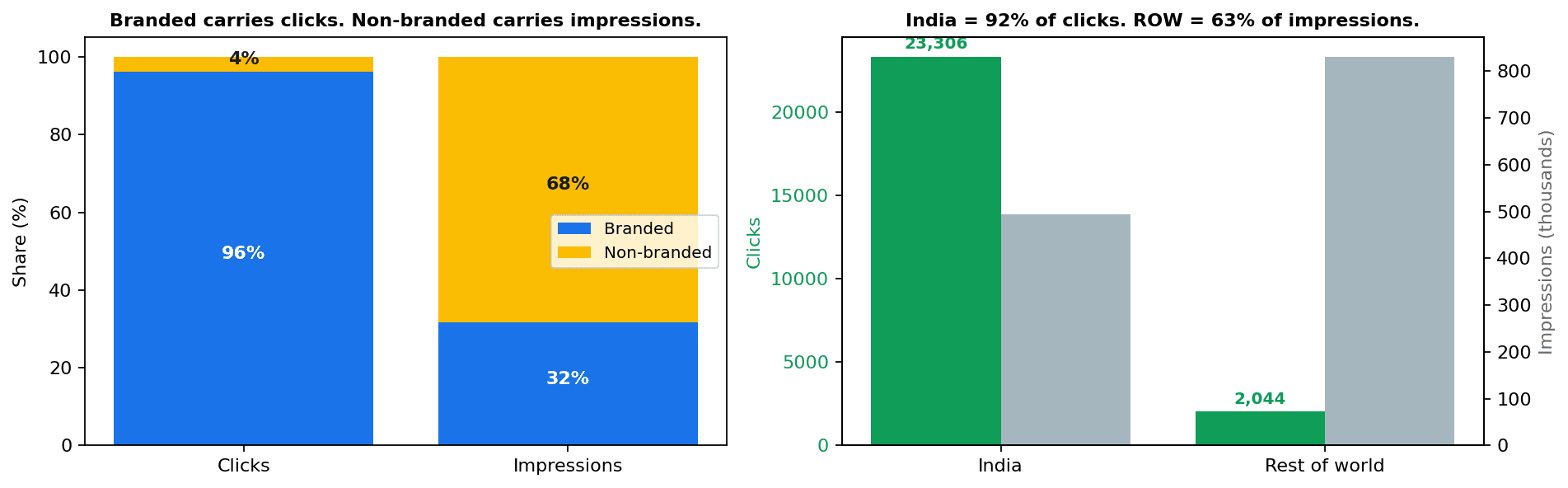
The split view is the strategic argument. Branded queries (96% of clicks, 32% of impressions) are the harvest. Non-branded queries (4% of clicks, 68% of impressions) are the planted field. The field is now visible. It has not been harvested.
India contributes 23,306 clicks against 493,316 impressions — a 4.72% CTR. The rest of the world contributes 2,044 clicks against 831,247 impressions — a 0.25% CTR. The international impressions are a mix of diaspora queries (Pakistan, UAE, Saudi, UK) and AI Overview-eaten queries (US, UK, Philippines). The same pattern that shows up in mature properties — visibility without click-through in AIO-heavy markets — is already visible here at scale.
What Is Working, What Is Not
Working: the homepage (12.02% CTR at position 3.1, 20,525 clicks from 170,716 impressions — the single largest click contributor). Branded discovery: position 1.0 for core brand variants; the diagnostic landing page at 43.2% CTR. Translated Results coverage: 289 clicks from 101,320 impressions on auto-translated surface.
Not yet working: click-through on the symptom corpus. Pages like 'is coconut water good for acidity' pull 139,817 impressions for 232 clicks (0.17% CTR at position 5.7). The page ranks; the title and meta description do not earn the click. Hindi content as a load-bearing pillar — only 17 Hindi-language queries in the top 1,000. The vernacular pattern that works in adjacent categories has not been replicated here yet.
Next Moves
SERP title and meta rewrites on the top 50 informational pages. These pages already rank; the click is being lost on the SERP, not on the page. Expected: 2–3x CTR on the targeted bucket inside 90 days.
FAQ schema deployment across the symptom corpus, paired with an answer-in-the-first-40-words rewrite. This compounds in two places — featured-snippet capture on traditional SERPs and citation eligibility in AI Overviews and generative answers.
Hindi-language content build-out. The vernacular wedge that has worked in adjacent verticals will work here; the prerequisite is publishing velocity, not strategy. Target: 50 high-intent Hindi URLs in Q3.
Begin LLM citation tracking on the top 30 category queries. This property is at the stage where being cited in generative answers will compound faster than being ranked in blue links.
Method Applied
One Sentence to Remember
“The field is planted. The harvest has not started. That is not a problem — it is a timeline.”
Gut Health Brand · Metrics as of May 2026
Get similar results
Start with a free AEO scan to see your baseline. No signup required.
Try the AEO Scanner Free