258% click growth. Page 3 to page 1 in 8 months.
A growth case study in SEO + AEO across content, technical, and off-page — with an honest account of the AEO cannibalization signal hiding inside the numbers.
+258%
Click Growth
+544%
Impression Growth
28.9 → 5.3
Position
135 outpulled 553 English
Hindi URLs
TL;DR
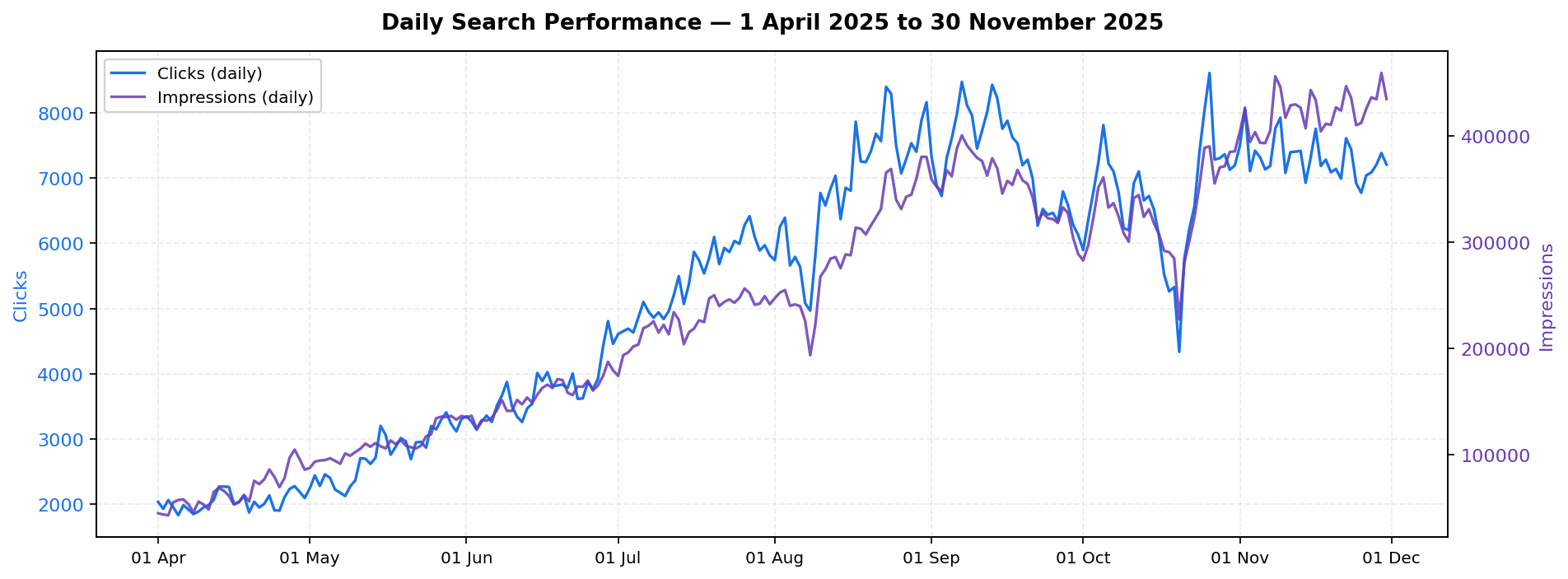
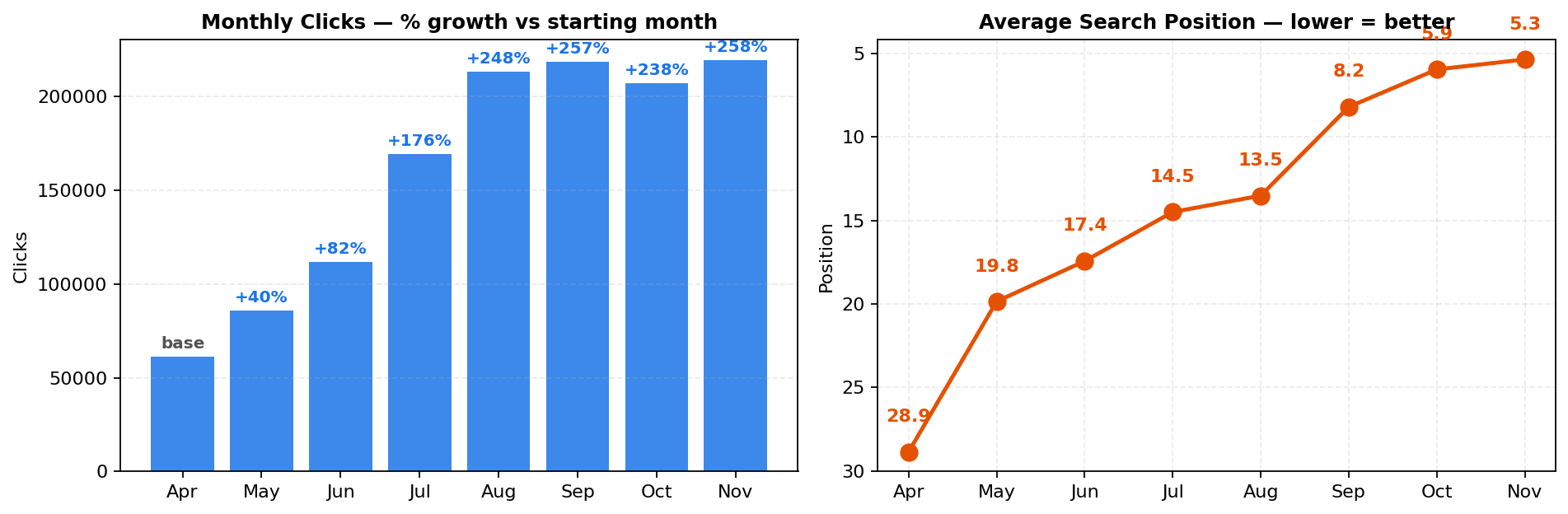
Eight months. The property grew from 61,238 monthly clicks to 219,092 — a 258% lift. Impressions grew from 1.97M to 12.69M — a 544% lift. Average rank moved from 28.9 (page 3) to 5.3 (top of page 1). Mobile is 84% of the traffic. India is 95% of the traffic. The blog does 53% of the work. 135 Hindi URLs are out-pulling 553 English URLs. And the CTR is falling on purpose — because Google's AI Overview is now eating the answer before the user clicks. That last sentence is the entire reason this document exists.
The Challenge
April 2025. The property was ranking on positions that don't exist on most users' screens. Average position 28.9 — for the non-Googlers in the room, that is the bottom of page 3. On a good day, 2,038 daily clicks. The CTR was actually decent (3.11%) because the small audience that did see us was high-intent. But CTR on a tiny base is the SEO equivalent of a great product nobody has heard of. Volume was missing.
Results
The Category Context
The category operates in three languages on the same day. English ("hair fall solution"), Hinglish ("hair fall kaise roke"), and Devanagari Hindi ("बाल झड़ना कैसे रोके"). Most competitors had English content only. That gap was the wedge. The rest of this case study is what we did with it.
The Hypothesis
Three bets, ordered by conviction. First: Hindi-language SEO content, built at scale, will out-pull English content at lower competition density. We bet vernacular over volume. Second: schema and rich-result deployment will turn impressions into rich impressions — not just ranks, but Product snippets, Merchant Listings, Translated Results, FAQ blocks. Third: the blog — not the homepage, not the PDP — will become the load-bearing wall of organic. We treated editorial as infrastructure, not as marketing.
We did not bet on backlinks doing the heavy lifting. Domain authority would follow rankings, not lead them. We did not bet on a viral content moment. We did not bet on a Google algorithm update being the catalyst. We built the infrastructure and let it compound.
Content Pillar — The Vernacular Wedge
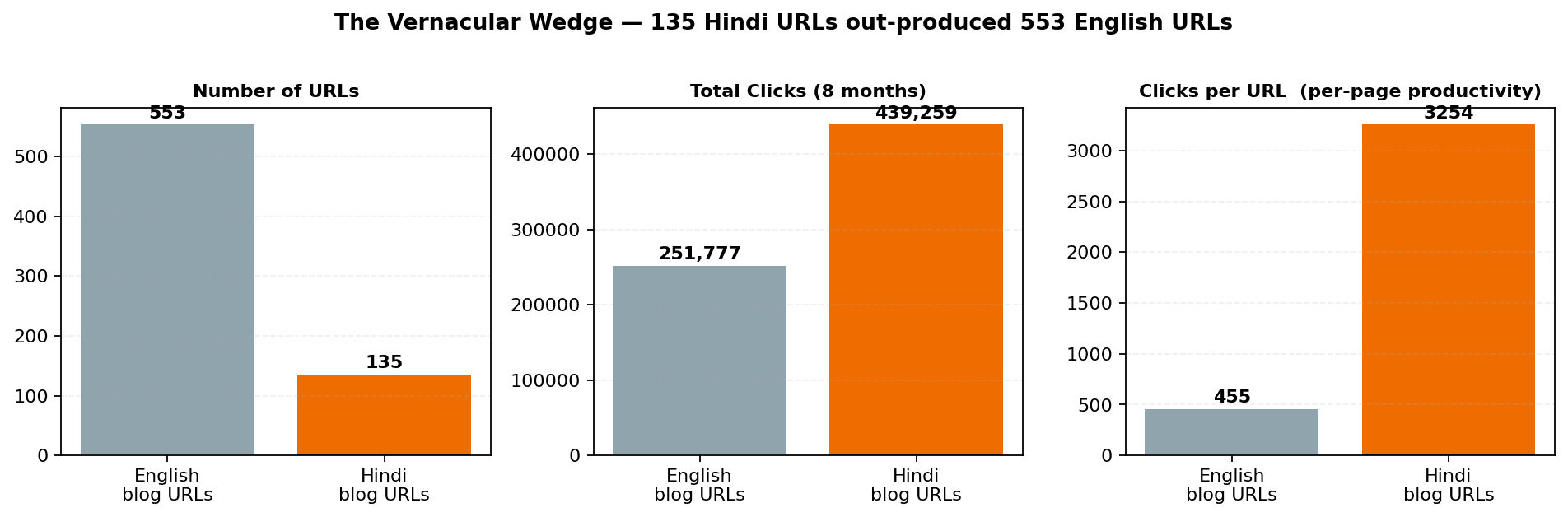
Eight months in: 688 blog URLs ranking on Google. 135 are in Devanagari Hindi. The Hindi URLs pulled 439,259 clicks against the English URLs' 251,777. Per-URL productivity: a Hindi blog earns approximately 3,254 clicks. An English blog earns approximately 455.
This is not because Hindi readers are louder. It is because the supply of high-quality Hindi content in this category was effectively zero. We were not competing for ranks — we were claiming them. A single well-structured Hindi URL on a high-intent hair-fall query ranks in the top 3 with no meaningful competition.
The content engine: hub-and-spoke topic clusters around the four canonical hair-fall stages. Every English piece on a high-intent topic gets a Hindi sibling within the same sprint. Devanagari URL slugs — unusual, but it ranks better for native-script queries and signals topical legitimacy to Google's language models. Answer-first paragraph structure: every post answers the headline in the first two sentences, then expands.
Technical Pillar — The Unglamorous, Correct Work
84% of clicks come from mobile (1,087,414 of 1,275,496 total clicks across known devices). Average mobile position: 6.7. Average desktop position: 35.7. We treated the desktop site as a derivative of the mobile experience, not the other way around.
Schema deployed where it earns. Product snippets: 114,566 clicks at average position 27.1, with a 2.31% CTR. A 2.31% CTR from page 3 is a rich-result CTR, not a blue-link CTR. Merchant Listings: 8,486 clicks at 3.27% CTR. Translated Results: 10,651 clicks at 1.45% CTR — Google auto-translating Hindi pages into Urdu, Arabic, and Bangla for SAARC and Gulf users. Most marketing teams don't know this feature exists.
Brand SERP defence: eight brand misspellings all rank positions 1–3, generating roughly 17,000 clicks across the period that would otherwise be lost to zero-result searches.
The AEO Pillar — The Inconvenient Truth
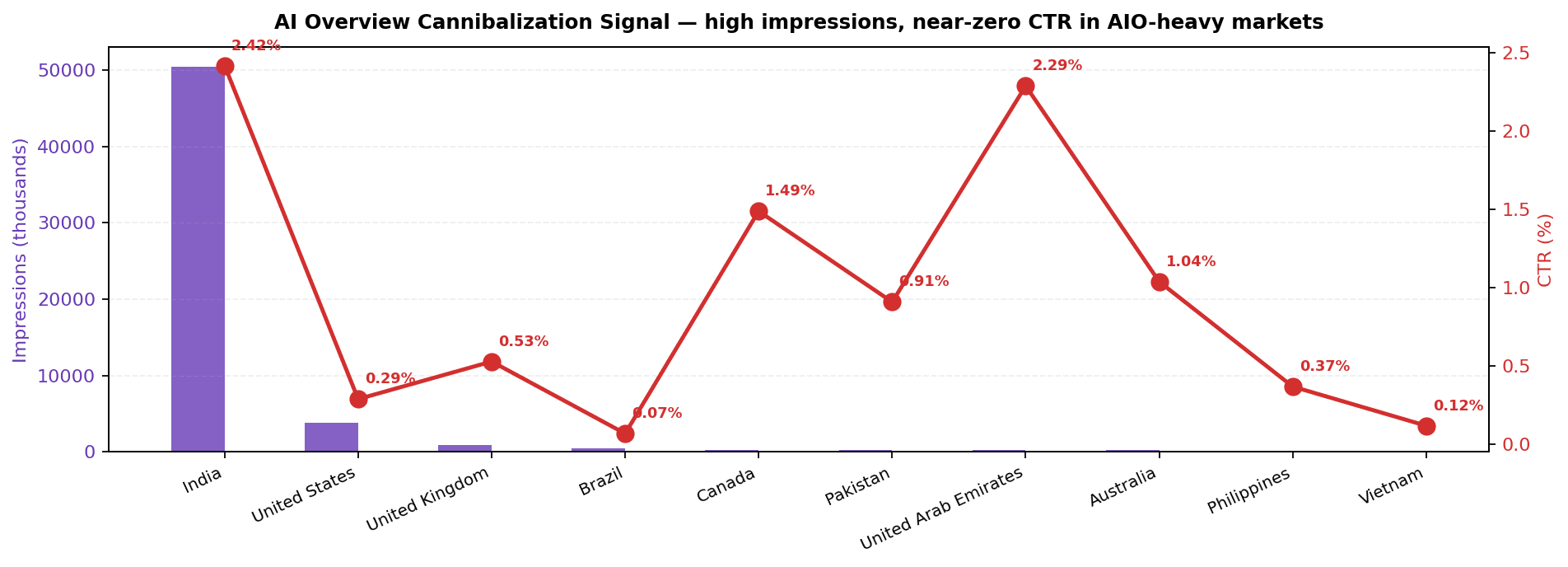
Average position improved from 28.9 to 5.3 — a 5.4x rank improvement. In any pre-2024 SEO playbook, that produces a CTR increase. Instead, CTR fell from 3.11% to 1.73%. Why?
Look at the geographic split. US: 3.84 million impressions, 11,113 clicks, CTR of 0.29%. UK: 867,911 impressions, 4,560 clicks, CTR of 0.53%. India CTR is 2.42% — roughly ten times higher than the US. The US and UK are markets with aggressive AI Overview rollout. India is not. The CTR collapse is not a content problem. It is an AI cannibalization signal.
This is the AEO era in one screen. Visibility without click-through. The board should understand that 'rank' is no longer the unit of measurement. Inclusion in the generative answer is. In response: every product, ingredient, and condition is now marked up as a defined entity. Content is being rewritten so the answer is in the first two sentences. Citation tracking is running across the top 50 category queries in ChatGPT, Perplexity, Gemini, and Google AI Overview.
Results
The two numbers to leave on the wall: 258% click growth in 8 months. 544% impression growth in 8 months. The third number — average position from 28.9 to 5.3 — is the one that matters most to a Google veteran. A rank improvement of that magnitude in 8 months is not the result of a single update. It is the result of content infrastructure that earned authority consistently.
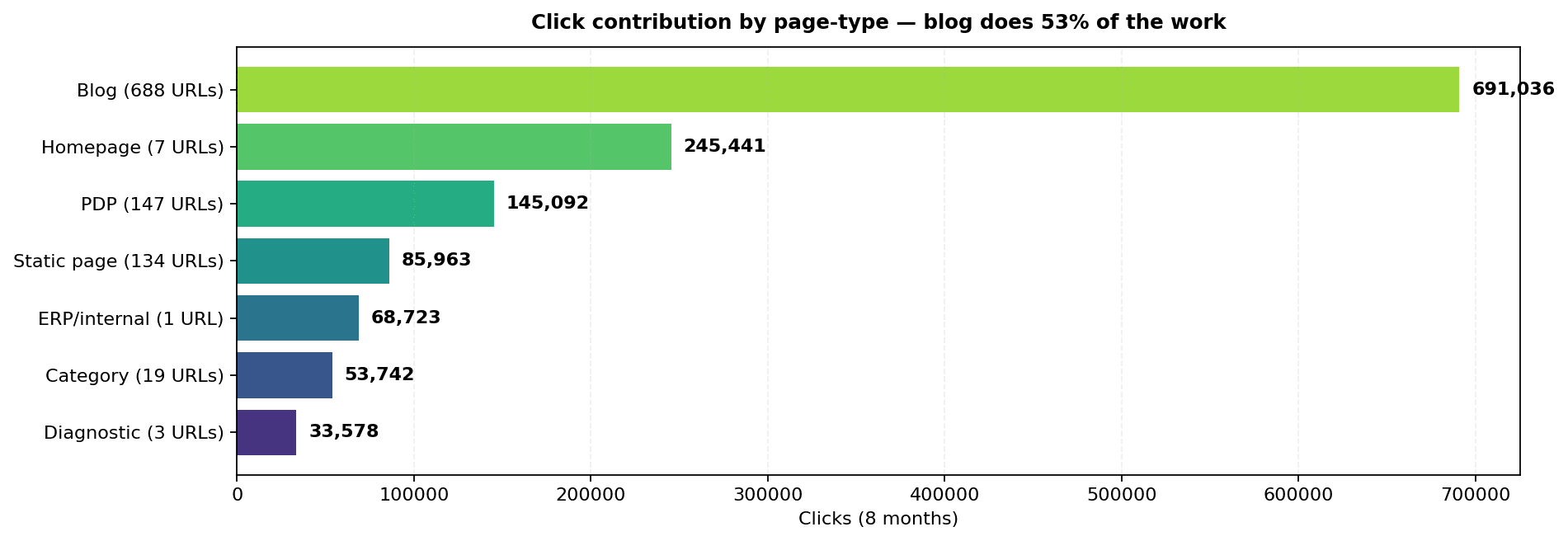
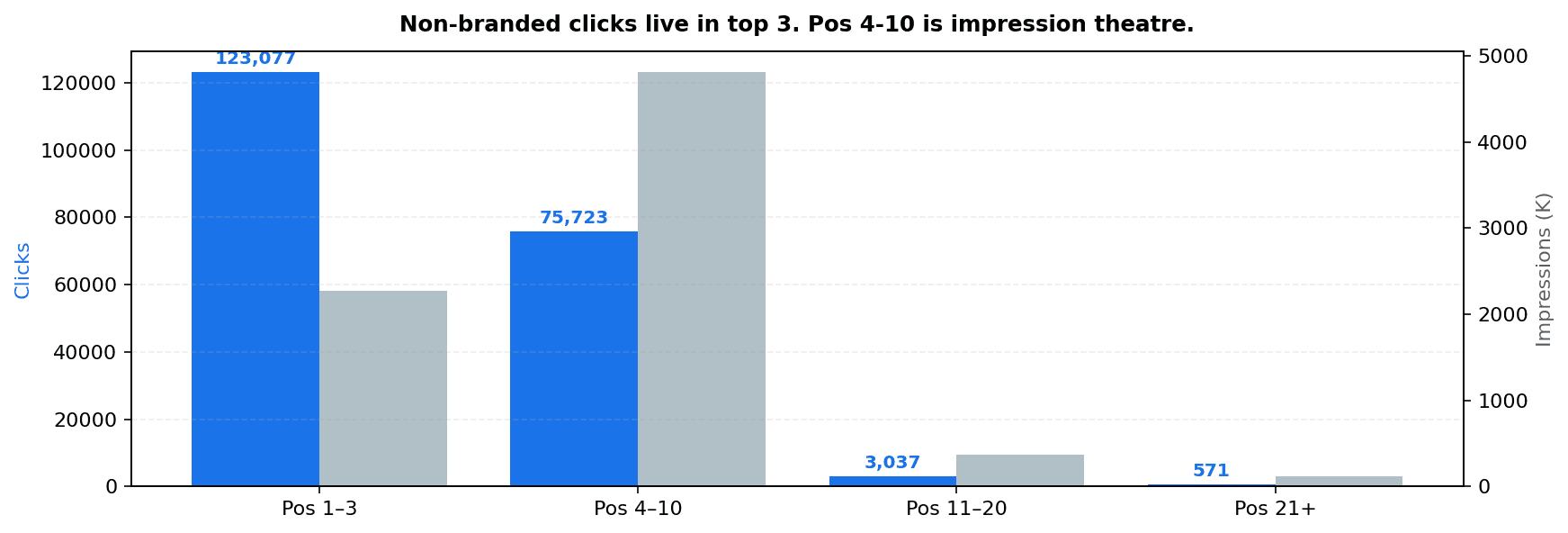
The blog corpus contributes 53% of organic clicks across 688 URLs. The homepage and PDPs contribute another 30%. 123,077 non-branded clicks come from positions 1–3. 75,723 from positions 4–10. 3,037 from positions 11–20. The rule that survived this engagement: every non-branded URL at position 4–10 is an investment in a future top-3 position. Every URL at 11–20 is a flag for editorial or technical intervention.
What Did Not Work
Multivitamin and biotin tablet queries: 268,753 impressions, 238 clicks, 0.09% CTR. We rank, we appear, no one clicks. The intent on that query is product-comparison, and our blog-format content does not match it.
English blog productivity flat-lined. Per-URL English productivity is ~455 clicks. Per-URL Hindi productivity is ~3,254. We over-invested in English content in months 2–4 and under-invested in Hindi. We corrected in month 5.
The internal company ERP login surfaces at 68,723 clicks at 89.29% CTR — employees finding their login. It muddies every external report. Migration to a non-indexed subdomain is in progress.
What Is Next
Build a comparison-content type for product-comparison queries (biotin, multivitamin, ingredient stacks) where we own the impression footprint and lose the click. Target: deploy 25 templates in Q3.
Move every top-50 category query into AIO-citation tracking. If we are absent from the generative answer for the category-defining queries by Q3, the rank does not matter. The KPI shifts from 'average position' to 'citation rate in top-5 generative answers.'
Replicate the Hindi vernacular wedge into one more vernacular language. Tamil and Bangla are the two that pencil out on per-capita category demand. Pilot 30 URLs each, measure click-per-URL against the Hindi baseline.
Begin LLM citation tracking via third-party tools (Profound, Otterly, Peec). Cross-check with manual prompt audits at a weekly cadence.
Method Applied
One Sentence to Remember
“The growth happened because we built for India's mobile-Hindi-first reality, deployed schema like it mattered, and stopped pretending CTR is a vanity metric in the AIO era. The rest is execution.”
Hair Wellness Brand · Metrics as of November 2025
Get similar results
Start with a free AEO scan to see your baseline. No signup required.
Try the AEO Scanner Free